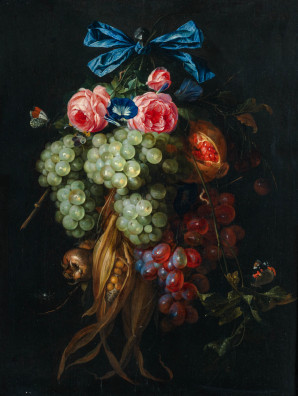
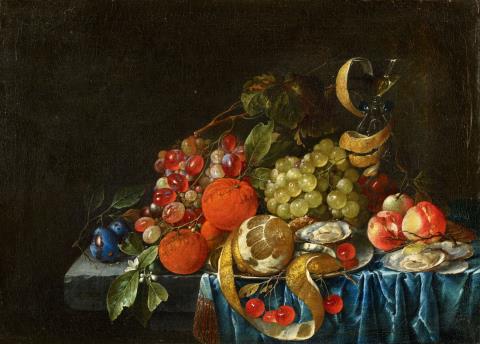
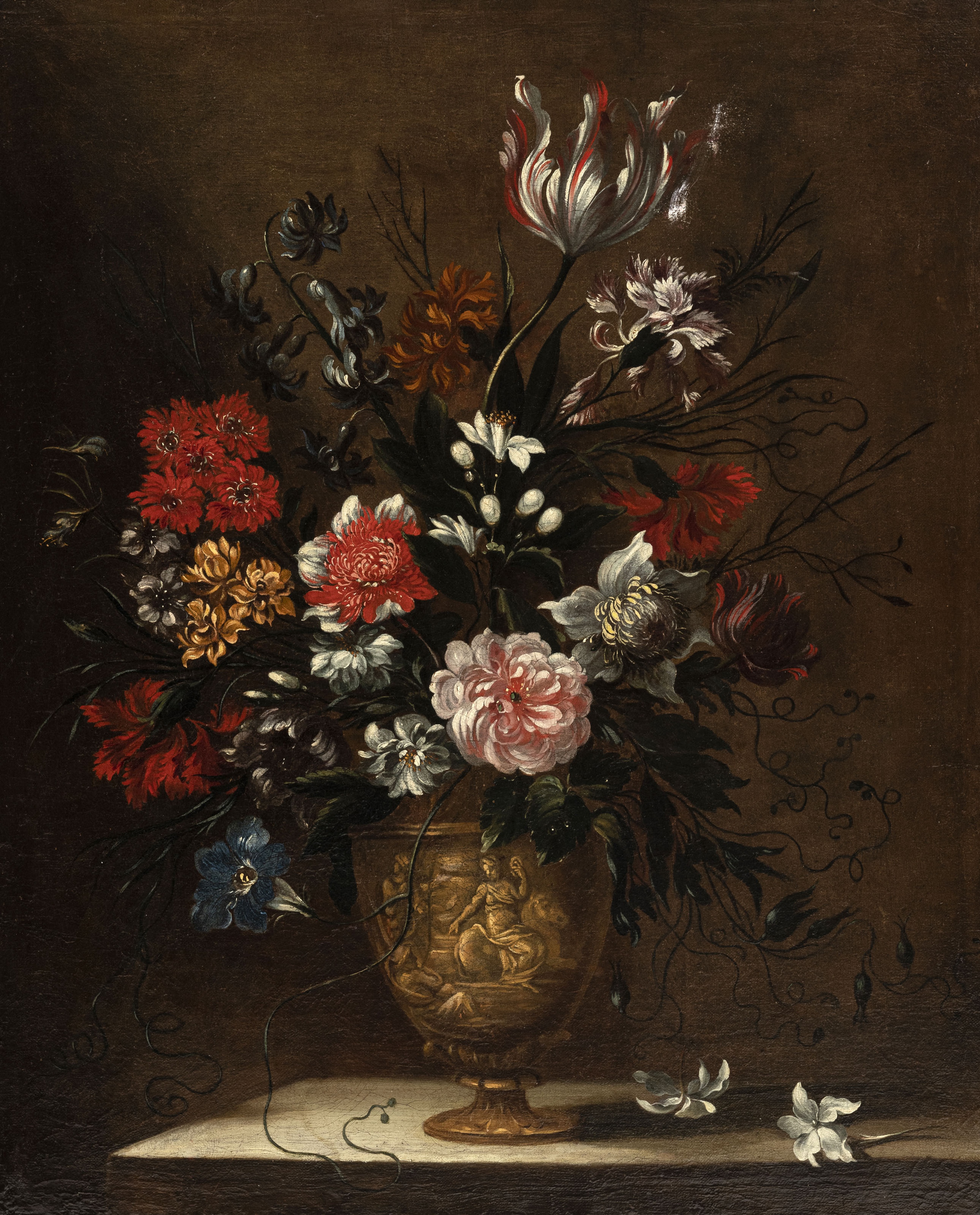
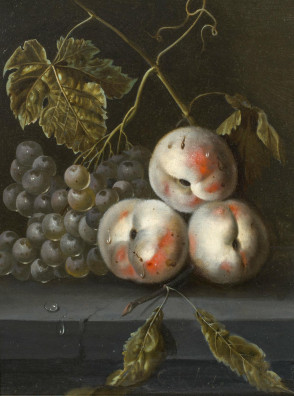
As a still-life painter, Cornelis de Heem developed his work in the wake of his father, Jan Davidszoon de Heem, whose son he was and who greatly inspired him. The closeness between their works often led to them being confused. A presentation by MUDAAC highlights, in one of his still lifes, the attention paid to the beauty of things and the challenge of rendering them: it notes the meticulous detail, the richness of the tonal range and the play of light, particularly on the fruits and the edge of a piece of porcelain.
Born in Leiden in 1631, he was the son of the still-life painter Jan Davidszoon de Heem. He arrived in Antwerp as a child in 1635 or 1636, when his father came to settle there, and died in the city in 1695. His career was linked to several artistic centres in the Netherlands: he became a member of the Antwerp painters’ guild in 1661 and stayed in Utrecht with his father in 1667. He is recorded in IJsselstein in 1676 and subsequently lived in The Hague from 1676 to 1690. There he joined the guild in December 1676, followed by the Confrerie Pictura in 1678. He in turn passed on his profession by teaching painting to his son, David Cornelisz de Heem.
Among the works that help situate his practice is Still Life with Fruit and Seafood, painted in oil on wood in 1659 and held at the Musée Fabre in Montpellier. Still Life with Flowers and Fruit, dated 1670, is listed at the Museum of Fine Arts in Ghent; a Garland of Fruit, painted in oil on panel, is held at the Bowes Museum. These examples form part of an oeuvre devoted primarily to still lifes.
This profile brings together identity references for Cornelis de Heem and paintings, drawings and works on paper documented in auction catalogues.
References include catalogue entries and available results; they do not all represent completed sales. Attributed works and special lots are excluded from the priced results.
SwissArtGallery documentary note based on the cited sources. Titles, media and qualifications are provided in the profile language; the original catalogue wording remains available in each record. Profile updated :
Pinchas Burstein (1927–1977), known as Maryan S. Maryan, was born in Nowy Sącz, Poland, and died in New York. Following a first solo exhibition in Jerusalem in 1949, he showed his wo…
Antonio Allegri, known as Correggio, who died in 1534, was a major figure of the Renaissance in Emilia. His work in Parma includes the dome frescoes of San Giovanni Evangelista and t…
Jacques-Philippe Caresme (1734–1796) worked in painting, drawing, pastel and watercolour. Exhibiting at the Salon from 1767, he undertook commissions for religious patrons and royal…