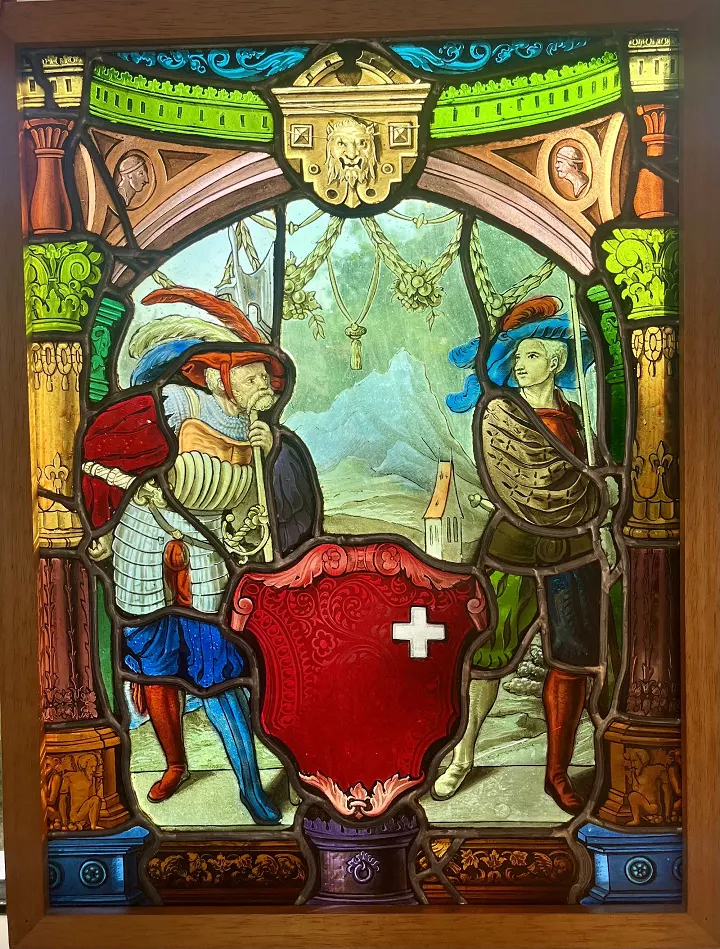
Vitrail aux deux gardes devant les armes de Schwytz
Artista non identificato
Riferimento swissart-0106
Disponibile500 CHFVetrata · 37 × 49 cm
1 / 6
Swiss Art Gallery
L’opera nel dettaglio
Questa standesscheibe di Schwytz colpisce per la chiarezza della sua costruzione e per l'intelligenza della sua ripresa storicista. Lo scudo con la croce bianca, posto come un nucleo visivo, è rispettosamente tenuto da due guardie cerimoniali riccamente vestite, le cui silhouette simmetriche conferiscono al pannello un'autorità quasi istituzionale. Intorno a loro, l'architettura dipinta, i medaglioni, le colonne e i rami ricompongono un decoro di prestigio che cita il Rinascimento senza cercare di imitarne l'austerità. Tutto è fatto affinché lo stemma rimanga leggibile, nobile e trionfante.
Il paesaggio alpino sullo sfondo conferisce una calma profondità a questa scena di affermazione civica. La montagna, la piccola costruzione e l'orizzonte chiaro non servono solo a riempire lo spazio: ricordano che qui l'identità cantonale è inseparabile da un territorio, da una topografia e da una memoria condivisa. La luce attraversa i vetri con una bella freschezza; i rossi rimangono potenti, i blu sono molto presenti e i verdi disegnano un quadro quasi teatrale. I ritocchi di grisaglia affinano i volti e gli ornamenti, mentre i piombi organizzano il disegno con precisione.
L'opera appartiene molto probabilmente a un historicismo neorinascimentale della fine del XIX secolo o dell'inizio del XX secolo, pensata come una citazione colta delle vetrate statali svizzere. La sua vicinanza di formato e spirito con la Standesscheibe di Schwytz conservata al Museo nazionale svizzero rafforza questa lettura. Non si tratta quindi dell'originale del XV secolo, ma di una ripresa antica che ne prolunga la solennità e la forza emblematica. Riguardo all'artista – nessun nome è certo per questo pannello; il pezzo rimane anonimo, ma si inserisce chiaramente nella tradizione della vetreria araldica svizzera resa famosa, fin dalla fine del Medioevo, da maestri come Lukas Zeiner.
Swiss Art Gallery vous accompagne dans votre acquisition.
Votre contact
Swiss Art Gallery · St-Prex. Facture nominative.
Paiement
TWINT, carte via Payrexx ou virement bancaire. Le total est présenté avant votre confirmation.
Préparer votre acquisition
Visite et remise
Visite à St-Prex sur rendez-vous. Retrait ou livraison selon les modalités convenues.
Informations et suivi
La galerie répond à vos questions et vous fournit les informations et photographies complémentaires disponibles.
Ihr Kunstkauf
Swiss Art Gallery begleitet Sie beim Erwerb dieses Werks.
Ihr Kontakt
Swiss Art Gallery · St-Prex. Rechnung auf Ihren Namen.
Zahlung
TWINT, Karte über Payrexx oder Banküberweisung. Der Gesamtbetrag wird vor Ihrer Bestätigung angezeigt.
Ihren Kunstkauf vorbereiten
Besichtigung und Übergabe
Besichtigung in St-Prex nach Vereinbarung. Abholung oder Lieferung gemäss Absprache.
Informationen und Betreuung
Die Galerie beantwortet Ihre Fragen und stellt verfügbare Informationen und ergänzende Fotografien bereit.
Your acquisition
Swiss Art Gallery guides you through your acquisition.
Your contact
Swiss Art Gallery · St-Prex. Invoice in your name.
Payment
TWINT, card via Payrexx or bank transfer. The total is shown before you confirm.
Prepare your acquisition
Viewing and handover
Viewing in St-Prex by appointment. Collection or delivery as agreed.
Information and follow-up
The gallery answers your questions and provides the available information and additional photographs.
Il vostro acquisto
Swiss Art Gallery vi accompagna nell’acquisto di quest’opera.
Il vostro contatto
Swiss Art Gallery · St-Prex. Fattura a vostro nome.
Pagamento
TWINT, carta tramite Payrexx o bonifico bancario. Il totale è indicato prima della conferma.
Preparare il vostro acquisto
Visita e consegna
Visita a St-Prex su appuntamento. Ritiro o consegna secondo gli accordi.
Informazioni e assistenza
La galleria risponde alle vostre domande e fornisce le informazioni disponibili e fotografie aggiuntive.
{"id":"swissart-0106","titre":"Vitrail aux deux gardes devant les armes de Schwytz","artiste":"Artiste non identifié","artiste_slug":null,"artiste_naissance":null,"artiste_deces":null,"attribution_statut":"artiste_non_identifie","attribution_cible":null,"signature":null,"signature_emplacement":null,"annee":null,"technique":"Vitrail peint et assemblé au plomb, avec grisaille et rehauts jaunes; panneau décoratif de tradition héraldique","technique_courte":"vitrail","technique_detail":"Vitrail peint et assemblé au plomb, avec grisaille et rehauts jaunes; panneau décoratif de tradition héraldique","support":"Verre avec cadre en bois","support_normalise":"bois","dimensions":"37 × 49 cm","dimensions_principales":"37 × 49 cm","dimensions_affiche":"37 × 49 cm","dimensions_oeuvre":null,"dimensions_encadrees":"37 × 49 cm","etat":"État apparent globalement bon: présence de salissures diffuses, une fissure en haut restaurée.","provenance_publique":null,"photos":["img/swissart-0106_1A.jpg","img/swissart-0106_1B.jpg","img/swissart-0106_1C.jpg","img/swissart-0106_1D.jpg","img/swissart-0106_1E.jpg","img/interiors/swissart-0106-291db81b15255358abee.jpg"],"categories":["scene-vie","portrait","decoratif"],"style":"Historicisme néo-Renaissance, dans la tradition des standesscheiben suisses","cadre":{"present":true},"prix_chf":500,"disponible":true,"reserve":false,"statut_professionnel":"disponible","maison_vente":null,"date_vente_encheres":null,"lot_vente":null,"url_vente_encheres":null,"description":"Cette standesscheibe de Schwytz frappe par la netteté de sa construction et par l’intelligence de sa reprise historiciste. L’écu à la croix blanche, posé comme un noyau visuel, est tenu en respect par deux gardes de cérémonie richement vêtus, dont les silhouettes symétriques donnent au panneau une autorité presque institutionnelle. Autour d’eux, l’architecture peinte, les médaillons, les colonnes et les rinceaux recomposent un décor de prestige qui cite la Renaissance sans chercher à en imiter l’austérité. Tout est fait pour que le blason demeure lisible, noble et triomphant.\n\nLe paysage alpin en arrière-plan apporte une profondeur calme à cette scène d’affirmation civique. La montagne, la petite construction et l’horizon clair ne servent pas seulement à meubler l’espace: ils rappellent qu’ici l’identité cantonale est inséparable d’un territoire, d’une topographie et d’une mémoire partagée. La lumière traverse les verres avec une belle fraîcheur; les rouges demeurent puissants, les bleus très présents, et les verts dessinent un cadre presque théâtral. Les rehauts de grisaille affinent les visages et les ornements, tandis que les plombs organisent le dessin avec précision.\n\nL’œuvre relève très vraisemblablement d’un historicisme néo-Renaissance de la fin du XIXe siècle ou du tout début du XXe siècle, pensé comme une citation savante des verrières d’État suisses. Sa proximité de format et d’esprit avec la Standesscheibe de Schwytz conservée au Musée national suisse renforce cette lecture. Il ne s’agit donc pas de l’original du XVe siècle, mais d’une reprise ancienne qui en prolonge la solennité et la force emblématique. À propos de l’artiste — aucun nom n’est assuré pour ce panneau; la pièce demeure anonyme, mais s’inscrit clairement dans la tradition de la verrerie héraldique suisse rendue célèbre, dès la fin du Moyen Âge, par des maîtres comme Lukas Zeiner.","description_de":"Diese Standesscheibe von Schwytz beeindruckt durch die Klarheit ihrer Konstruktion und die Intelligenz ihrer historisierenden Wiederaufnahme. Das Wappen mit dem weißen Kreuz, das als visuelles Zentrum dient, wird von zwei reich gekleideten Zeremonienwachen respektvoll gehalten, deren symmetrische Silhouetten dem Panel eine fast institutionelle Autorität verleihen. Um sie herum rekonstruieren die gemalte Architektur, die Medaillons, die Säulen und die Ranken ein prestigeträchtiges Dekor, das die Renaissance zitiert, ohne deren Strenge nachzuahmen. Alles ist darauf ausgelegt, dass das Wappen lesbar, edel und triumphierend bleibt.\n\nDie alpine Landschaft im Hintergrund verleiht dieser Szene der bürgerlichen Bekräftigung eine ruhige Tiefe. Der Berg, das kleine Bauwerk und der klare Horizont dienen nicht nur zur Ausfüllung des Raumes: Sie erinnern daran, dass hier die kantonale Identität untrennbar mit einem Territorium, einer Topographie und einem gemeinsamen Gedächtnis verbunden ist. Das Licht durchdringt die Gläser mit einer schönen Frische; die Rottöne bleiben kraftvoll, die Blautöne sind sehr präsent, und die Grüntöne zeichnen einen fast theatralischen Rahmen. Die Graufarben verfeinern die Gesichter und Ornamente, während die Bleiränder das Design präzise organisieren.\n\nDas Werk gehört sehr wahrscheinlich zu einem neorenaissancistischen Historismus aus dem späten 19. Jahrhundert oder dem frühen 20. Jahrhundert, gedacht als eine gelehrte Anspielung auf die Staatsfenster der Schweiz. Die Nähe in Format und Geist zur Standesscheibe von Schwytz, die im Schweizer Nationalmuseum aufbewahrt wird, verstärkt diese Lesart. Es handelt sich also nicht um das Original aus dem 15. Jahrhundert, sondern um eine alte Wiederaufnahme, die dessen Feierlichkeit und emblematische Kraft verlängert. Was den Künstler betrifft – kein Name ist für dieses Panel gesichert; das Stück bleibt anonym, fügt sich jedoch klar in die Tradition der schweizerischen Heraldik-Glasmalerei ein, die bereits seit dem späten Mittelalter von Meistern wie Lukas Zeiner berühmt gemacht wurde.","description_en":"This standesscheibe from Schwytz impresses with the clarity of its construction and the intelligence of its historicist revival. The shield with the white cross, serving as a visual core, is respectfully held by two richly dressed ceremonial guards, whose symmetrical silhouettes lend the panel an almost institutional authority. Surrounding them, the painted architecture, the medallions, the columns, and the scrolls reconstruct a prestigious decor that cites the Renaissance without attempting to imitate its austerity. Everything is designed to ensure that the coat of arms remains legible, noble, and triumphant.\n\nThe alpine landscape in the background adds a calm depth to this scene of civic affirmation. The mountain, the small structure, and the clear horizon do not merely fill the space: they remind us that here, cantonal identity is inseparable from a territory, a topography, and a shared memory. The light passes through the glass with a beautiful freshness; the reds remain powerful, the blues are very present, and the greens create an almost theatrical frame. The grisaille highlights refine the faces and ornaments, while the lead lines organize the design with precision.\n\nThe work very likely belongs to a neo-Renaissance historicism from the late 19th century or the very early 20th century, conceived as a learned citation of Swiss state windows. Its proximity in format and spirit to the standesscheibe from Schwytz preserved in the Swiss National Museum reinforces this interpretation. Thus, it is not the original from the 15th century, but an old revival that prolongs its solemnity and emblematic strength. Regarding the artist – no name is assured for this panel; the piece remains anonymous, but clearly fits into the tradition of Swiss heraldic glassmaking made famous, since the late Middle Ages, by masters like Lukas Zeiner.","description_it":"Questa standesscheibe di Schwytz colpisce per la chiarezza della sua costruzione e per l\u0027intelligenza della sua ripresa storicista. Lo scudo con la croce bianca, posto come un nucleo visivo, è rispettosamente tenuto da due guardie cerimoniali riccamente vestite, le cui silhouette simmetriche conferiscono al pannello un\u0027autorità quasi istituzionale. Intorno a loro, l\u0027architettura dipinta, i medaglioni, le colonne e i rami ricompongono un decoro di prestigio che cita il Rinascimento senza cercare di imitarne l\u0027austerità. Tutto è fatto affinché lo stemma rimanga leggibile, nobile e trionfante.\n\nIl paesaggio alpino sullo sfondo conferisce una calma profondità a questa scena di affermazione civica. La montagna, la piccola costruzione e l\u0027orizzonte chiaro non servono solo a riempire lo spazio: ricordano che qui l\u0027identità cantonale è inseparabile da un territorio, da una topografia e da una memoria condivisa. La luce attraversa i vetri con una bella freschezza; i rossi rimangono potenti, i blu sono molto presenti e i verdi disegnano un quadro quasi teatrale. I ritocchi di grisaglia affinano i volti e gli ornamenti, mentre i piombi organizzano il disegno con precisione.\n\nL\u0027opera appartiene molto probabilmente a un historicismo neorinascimentale della fine del XIX secolo o dell\u0027inizio del XX secolo, pensata come una citazione colta delle vetrate statali svizzere. La sua vicinanza di formato e spirito con la Standesscheibe di Schwytz conservata al Museo nazionale svizzero rafforza questa lettura. Non si tratta quindi dell\u0027originale del XV secolo, ma di una ripresa antica che ne prolunga la solennità e la forza emblematica. Riguardo all\u0027artista – nessun nome è certo per questo pannello; il pezzo rimane anonimo, ma si inserisce chiaramente nella tradizione della vetreria araldica svizzera resa famosa, fin dalla fine del Medioevo, da maestri come Lukas Zeiner.","date_ajout":"2026-08-26","ordre":null,"seo_meta_descriptions":{"fr":"Artiste non identifié — Vitrail aux… Vitrail, 37 × 49 cm, 500 CHF. Visite à St-Prex.","de":"Unbekannter Künstler — Vitrail aux deux gardes devant les armes de Schwytz. Glasmalerei, 37 × 49 cm, 500 CHF. Besichtigung in St-Prex.","en":"Unidentified artist — Vitrail aux deux gardes devant les armes de Schwytz. Stained glass, 37 × 49 cm, 500 CHF. View in St-Prex.","it":"Artista non identificato — Vitrail aux deux gardes devant les armes de Schwytz. Vetrata, 37 × 49 cm, 500 CHF. Visita a St-Prex."},"artiste_profil_disponible":false}
[{"id":"swissart-0076","artiste":"Sabina Mirri","titre":"Man in bath","prix_chf":200,"artiste_slug":"sabina-mirri","attribution_cible":"Sabina Mirri","attribution_statut":"autographe","technique_courte":"aquarelle_gouache","statut_professionnel":"disponible","sag_related_href":"/oeuvre/swissart-0076/man-in-bath-sabina-mirri/?lang=it","sag_related_image":"/img/swissart-0076_1A-card-320.webp","photos":["img/swissart-0076_1A.jpg"]},{"id":"swissart-0100","artiste":"Artiste non identifié","titre":"Atelier de forge","prix_chf":80,"statut_professionnel":"disponible","artiste_naissance":null,"artiste_deces":null,"artiste_slug":null,"attribution_statut":"artiste_non_identifie","attribution_cible":null,"technique_courte":"sculpture_relief","sag_related_href":"/oeuvre/swissart-0100/atelier-de-forge/?lang=it","sag_related_image":"/img/swissart-0100_1A-card-320.webp","photos":["img/swissart-0100_1A.jpg"]},{"id":"swissart-0073","artiste":"Shunichi Kadowaki","titre":"Kagoshima Jingū – Hatsu-uma Matsuri","prix_chf":180,"artiste_slug":"shunichi-kadowaki","artiste_naissance":"1913","artiste_deces":"2006","attribution_cible":"Shunichi Kadowaki","attribution_statut":"autographe","technique_courte":"estampe_multiple","statut_professionnel":"disponible","sag_related_href":"/oeuvre/swissart-0073/kagoshima-jingu-hatsu-uma-matsuri-shunichi-kadowaki/?lang=it","sag_related_image":"/img/swissart-0073_1A-card-320.webp","photos":["img/swissart-0073_1A.jpg"]}]
Informations sur l’œuvre
Nature / technique
Vitrail
Dimensions avec cadre
37 × 49 cm
État de conservation
État apparent globalement bon: présence de salissures diffuses, une fissure en haut restaurée.
Attribution
Artiste non identifié
Contactez la galerie pour préciser la provenance, l’état de conservation ou les documents d’accompagnement de cette œuvre.