Albert Anker · 5 min read
The school that did not look like a reassuring image
In 1858, Anker observed life in a Black Forest village. The classroom he derived from it entered the Paris Salon the following year, with a vision of education far less peaceful than his reputation might lead us to expect.
Published on October 3, 2026
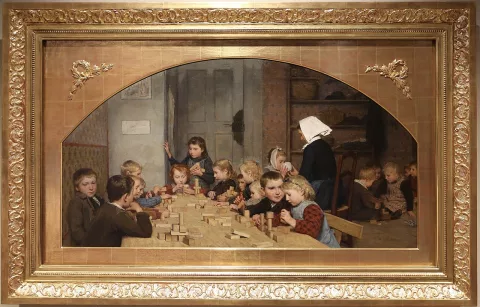
The room is full, the schoolmaster stands, and several children occupy difficult positions before him. A Village School in the Black Forest does not immediately offer the gentleness often associated with Albert Anker. The gaze moves from one face to another and observes differences in place, activity and reaction. The painting presents a collective situation, but learning does not seem equally distributed within it. The celebrated image of peaceful childhood becomes more complicated as soon as we linger over the relationships between the children and their teacher.
The Kunstmuseum Bern situates the painting’s starting point in autumn 1858. Anker travelled to the Black Forest with the painter Ludwig Knaus and stayed for several weeks in Biberach. The documentation describes his interest in the village community. This context of observation is essential, but it does not turn the painting into a photograph of a precise lesson. The painting composes a situation from fieldwork. It lets us see an exploration of education and rural life without giving us the minutes of an entirely identifiable school day.
The teacher’s presence structures the space. Standing at his desk, he possesses means of authority the children do not have. Several figures are placed in a direct relationship with him; the others are distributed around the room and react differently. The visitor can follow this network without needing to hear the words that might have been spoken. Positions are enough to construct a hierarchy. One person stands upright, others wait or work; the material space becomes the place where a difference in power becomes immediately visible.
The distribution between girls and boys introduces another question. The museum notes that boys occupy most of the bench seats, while girls participate differently and are often occupied with knitting. The painting invites us to observe this distribution rather than consider the room an undifferentiated group of children. Where can one sit, what can one do, towards whom can one look? These concrete questions make the scene intelligible. They show how an institution is also inscribed in bodies, objects and the possibilities of movement granted to each person.
Darkness and crowding give the classroom a particular atmosphere. The visitor does not enjoy a free space in which every figure would be calmly isolated. We must search, follow a face and observe another presence interrupting it. This density can make the situation’s difficulty felt without reducing the image to a denunciation written in paint. Anker preserves individual differences. The group is subject to a shared organisation, but each person seems to have a way of being present within it, making the gaze more attentive and less automatically generalising.
The painting became the first work Anker presented at the Paris Salon, in 1859. The museum reports its purchase by a collector from Glasgow. A scene observed in a village thus quickly circulated within an international network. This journey changed its public: school relationships became a subject of painting for visitors far from Biberach. The story shows that Anker’s rural realism did not remain enclosed in a single local context. It was also constructed for exhibition and met gazes that could recognise more widely shared questions within it.
Before the children, we must maintain a distinction between visible gestures and the lives we might be tempted to invent. The painting allows us to feel anxiety, fatigue or concentration; it does not provide every pupil’s biography. A painted expression is not direct testimony of their speech. This restraint protects precisely the work’s strength. We can look attentively at differences in place and activity without adding individual stories that would make us forget the concrete construction of this collective experience.
At the end of the journey, Anker’s name takes on a less comfortable and more precise dimension. The artist of childhood also observes the constraints running through it. The Black Forest classroom is not merely an old setting in which to seek the picturesque; it is a set of relationships whose weight the painting makes us feel. The painting that travelled to Paris retains this capacity for attention. It invites us to look at places of learning through the positions they give, the gestures they allow and the differences an overly reassuring image would easily have left in shadow.