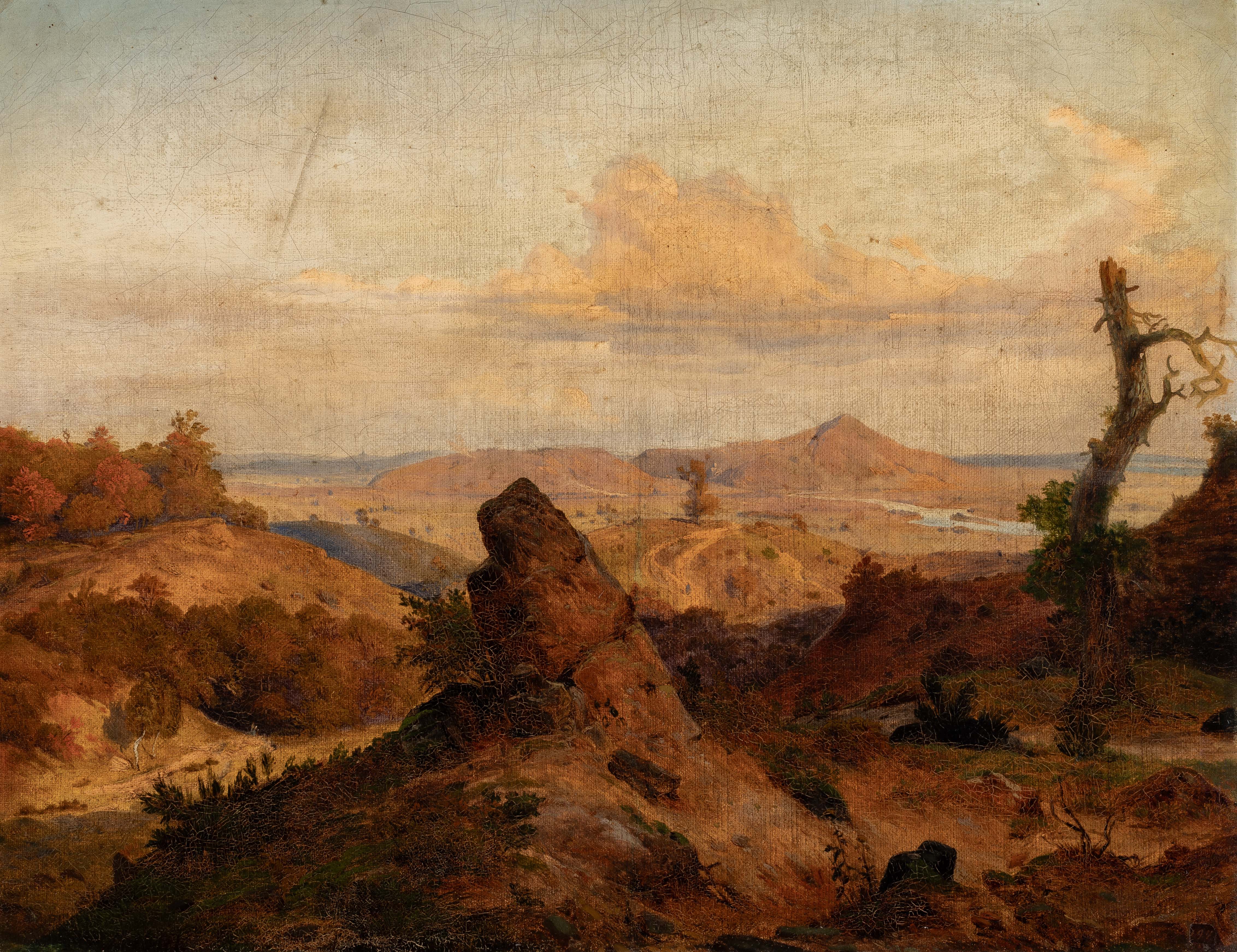
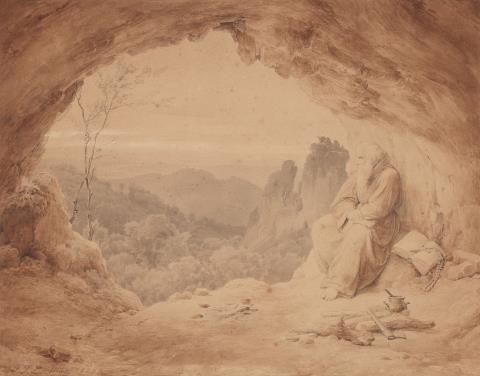
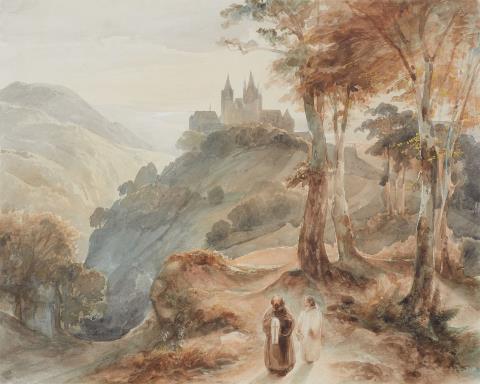
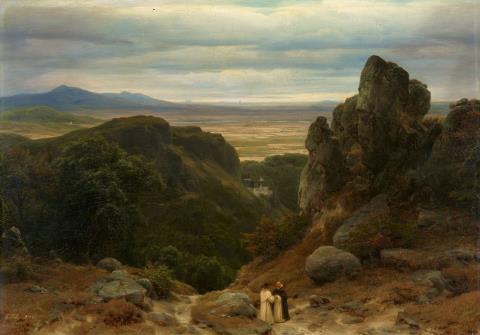
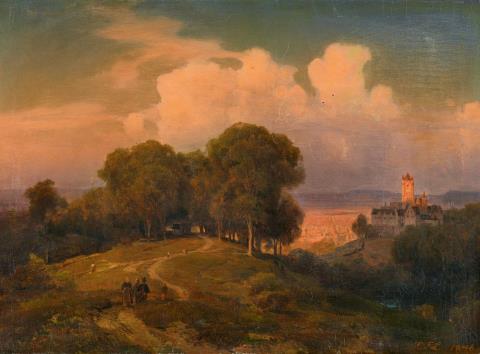
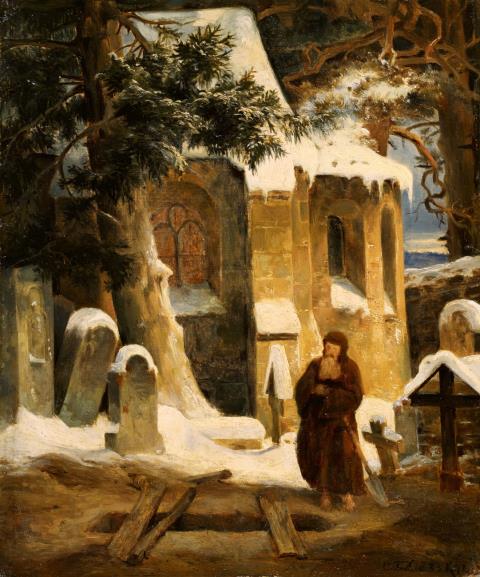
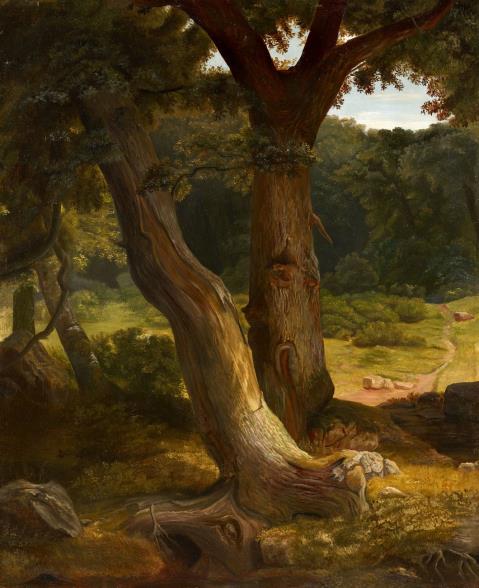
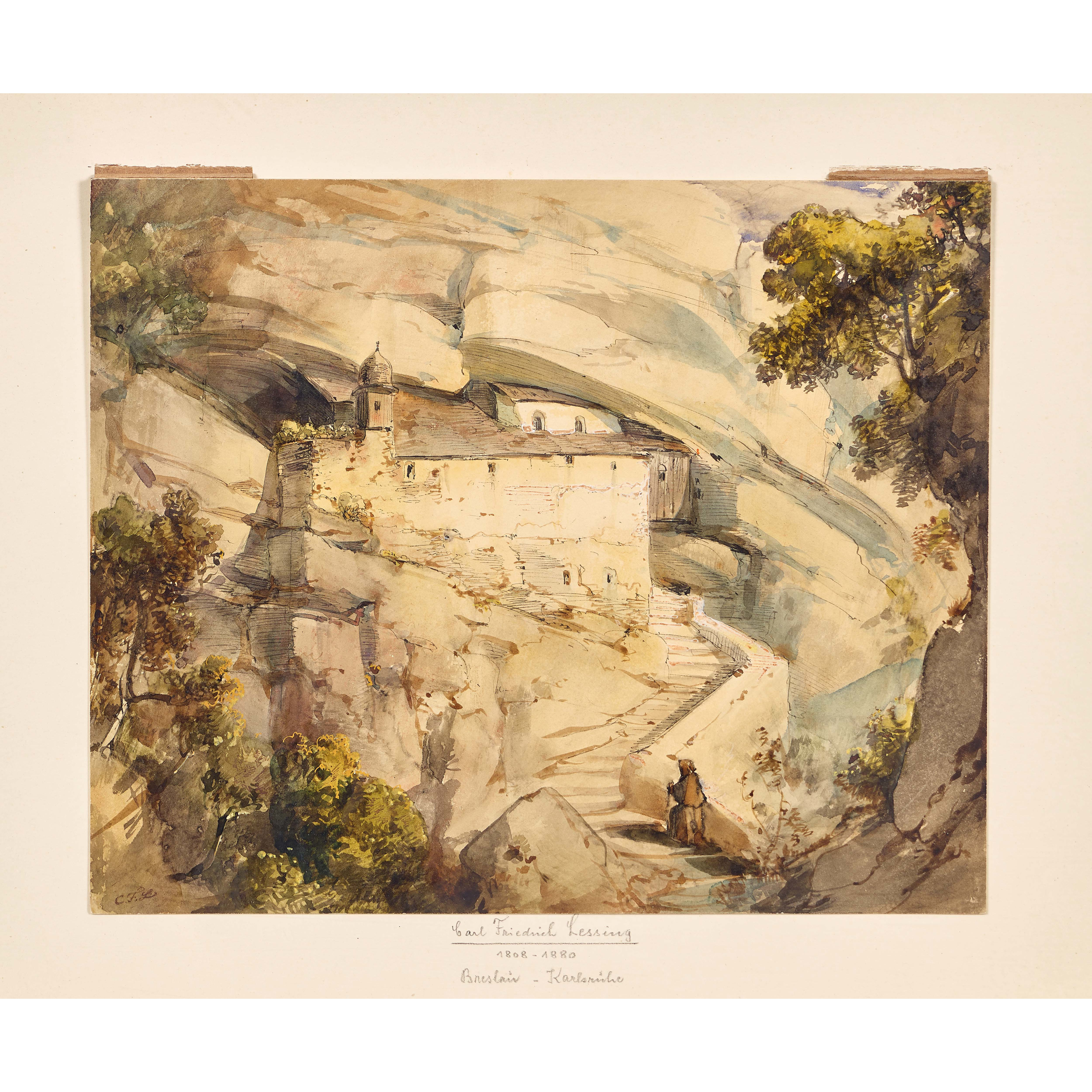
The German history and landscape painter Carl Friedrich Lessing first distinguished himself through dark and imaginative Romantic landscapes, which often feature castle ruins and abandoned cemeteries. Born in Breslau, Prussia, in 1808, he joined Friedrich Wilhelm von Schadow at the Düsseldorf Academy of Fine Arts in 1826, where he was associated with the Düsseldorf School of Painting; the following year, he studied landscape painting with Johann Wilhelm Schirmer. As early as 1825, the presentation and subsequent sale of Kirchhof mit Leichensteinen und Ruinen im Schnee helped reconcile his father to his career choice. Among his landscapes, Klosterhof im Schnee, dated 1829, is recorded at the Wallraf-Richartz Museum in Cologne; Das trauernde Königspaar, from 1830, is held at the Hermitage in Saint Petersburg.
Encouraged by Schadow to take up history painting, Lessing received a commission for frescoes devoted to the life of Frederick Barbarossa at Heltorf Castle, near Düsseldorf. He completed part of a monumental depiction of the Battle of Iconium before abandoning work on the mural. Die Hussitenpredigt, dated 1836 and counted among his best-known works, circulated in Germany and France. Appointed professor by King Frederick William IV in 1848, he was among the first artists to receive the Pour le Mérite medal. He was also a member of the Prussian Academy and presided over the artists’ association Malkasten.
This profile brings together identity references for Karl Friedrich Lessing and paintings, drawings and works on paper documented in auction catalogues.
8 references are documented at Zofingen, Dobiaschofsky, Lempertz. Each record links to its source; the amounts are not a general valuation of the artist’s work.
SwissArtGallery documentary note based on the cited sources. Titles, media and qualifications are provided in the profile language; the original catalogue wording remains available in each record. Documentation updated : 2026-10-19