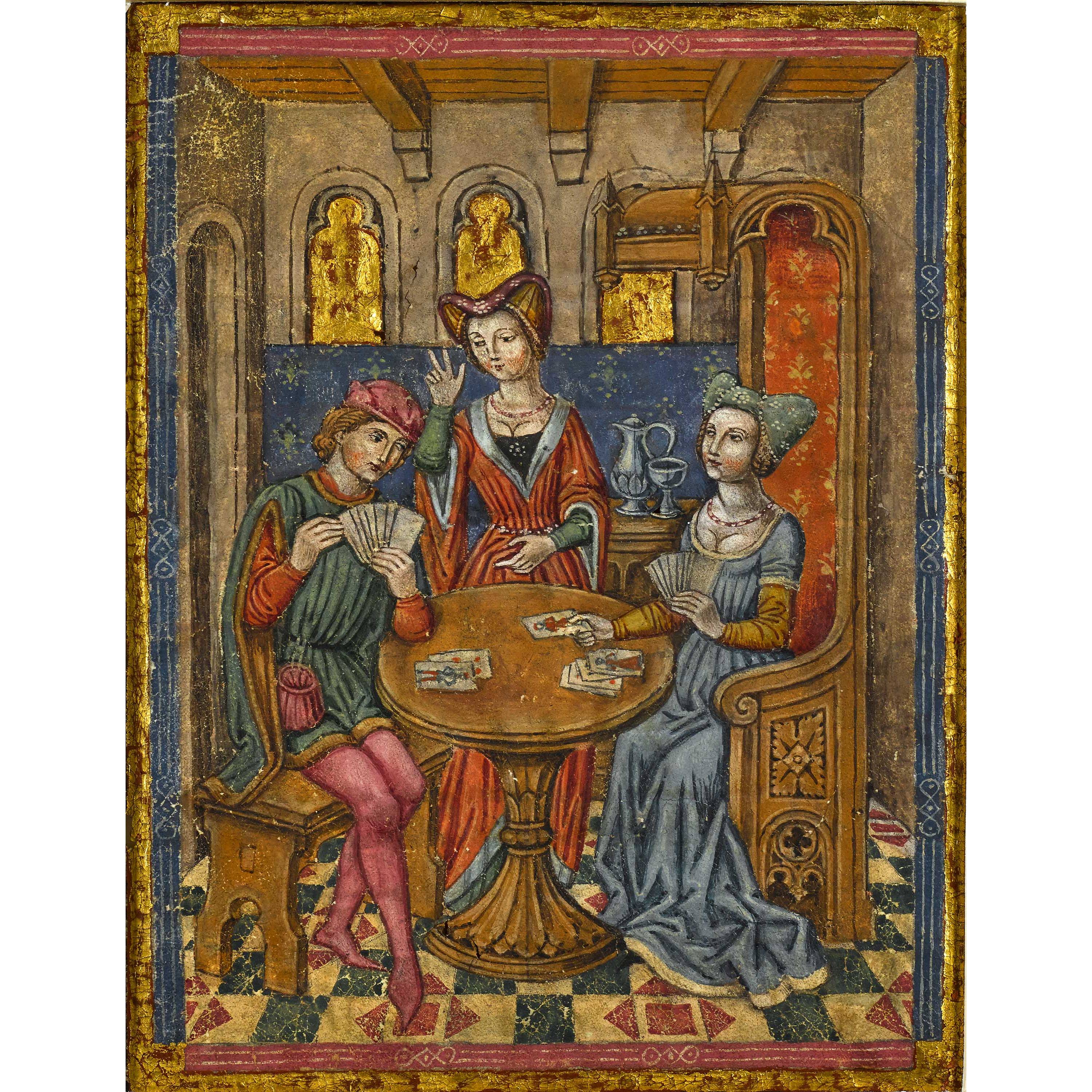
The Spanish Forger is the conventional name of an anonymous painter and illuminator active in the late nineteenth and early twentieth centuries, probably in Paris. The name does not establish Spanish origins: it derives from an earlier attribution to a Spanish master. The maker’s civil identity and life dates remain unknown.
These paintings and illuminations imitate medieval art by recombining historical motifs into religious or courtly scenes, often with sweetened facial expressions. Iconographic inconsistencies helped expose the fabrications. Around 1930, Belle da Costa Greene, director of the Morgan Library, began identifying and grouping the works. In 1978, the institution devoted an exhibition to this body of material, which became a subject for studying forgery and the modern fascination with the Middle Ages.
This profile brings together identity references for Spanish Forger and paintings, drawings and works on paper documented in auction catalogues.
Documented auction references
3auction references
1auction house
2documented results with prices
Dobiaschofsky
References include catalogue entries and available results; they do not all represent completed sales. Attributed works and special lots are excluded from the priced results.
SwissArtGallery documentary note based on the cited sources. Titles, media and qualifications are provided in the profile language; the original catalogue wording remains available in each record. Profile updated :
Sadegh Tabrizi, born in Tehran in the late 1930s and deceased in London in 2017, was an Iranian painter and calligrapher associated with the Saqqakhaneh movement. Trained in miniatur…
Emil Barbarini, born in Vienna in 1855, was an Austrian painter of landscapes and urban scenes. He received his initial training from his father, the landscape painter Franz Barbarin…
Jan Voss, born in Hamburg in 1936, studied at Munich’s Academy of Fine Arts from 1956 to 1960 before settling in Paris. He contributed to the journal KWY and participated in exhibiti…