Paul Thek’s career is marked by the Technological Reliquaries, which were the subject of three solo exhibitions at the Stable Gallery and Pace Gallery in New York between 1964 and 1967. After his works were first presented at the Mirrell Gallery in Miami in 1957, he held his first solo exhibition at the Stable Gallery in New York in 1964. In 1962, he travelled to Italy with the photographer Peter Hujar and visited the Capuchin Catacombs in Palermo; five years later, he received a Fulbright grant for Italy. Among his works from this period, The Tomb (1967) takes the form of a pink ziggurat-shaped structure containing an effigy of the artist, made using a mannequin and casts of his face, hands and feet.
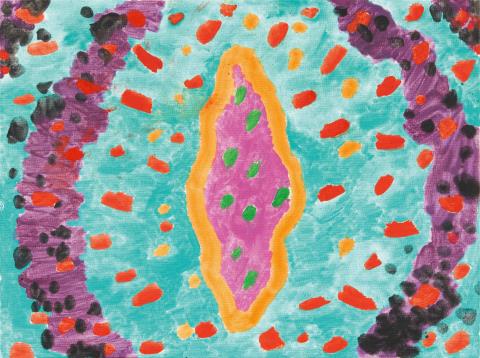
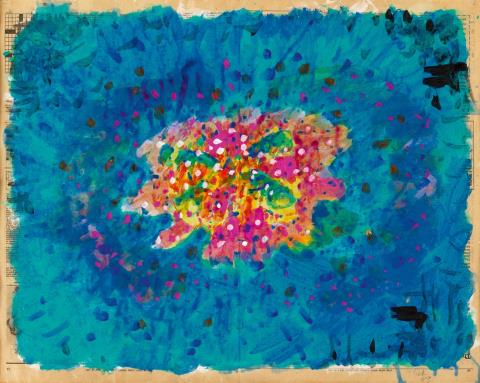
During his stay in Europe, Thek developed a series of related installations with several collaborators: The Procession/The Artist’s Co-op (1969), Pyramid/A Work in Progress (1971-1972), Ark, Pyramid (1972) and Ark, Pyramid, Easter (1973). He established his permanent residence in New York in 1976 and later taught at Cooper Union, notably in 1978 and 1980. A 1984 work, Ohne Titel (Cell), is described as acrylic paint on canvas mounted on cardboard, measuring 45.5 × 61 cm.
The circulation of his work is also documented by the exhibition Paul Thek, In the Context of Today’s Contemporary Art, presented in Karlsruhe in 2008 and then in Hamburg and Madrid in 2009. In 2010, the Whitney Museum of American Art organised Diver, a Retrospective, described as the first American retrospective devoted to his work. Works by the artist are also on permanent display at the Watermill Center in New York State.
This profile brings together identity references for Paul Thek and paintings, drawings and works on paper documented in auction catalogues.
Documented auction references
7auction references
1auction house
7documented results with prices
Lempertz
References include catalogue entries and available results; they do not all represent completed sales. Attributed works and special lots are excluded from the priced results.
SwissArtGallery documentary note based on the cited sources. Titles, media and qualifications are provided in the profile language; the original catalogue wording remains available in each record. Profile updated :
Known as Master IW or the Monogrammist I.W., this artist is presented as a Czech or Saxon Renaissance painter, active between 1520 and 1550, mainly in north-western Bohemia; the mono…
The German painter and lithographer Wilhelm Volz (1855–1901) is also listed as a painter of historical, genre and landscape scenes, as well as an illustrator and etcher. These detail…
A painter of the Florentine school, Agnolo Gaddi worked at Santa Croce on several painted ensembles and on the choir stained-glass windows. In the Castellani Chapel, he painted scene…